
The Best of Ankara: Why Anıtkabir is a Must-Visit for Every Traveler
TL;DR: Anitkabir is Ankara’s must‑see landmark—home to Atatürk’s mausoleum, the iconic Lions Road, and the Changing of the Guard. This guide covers what to see and the site’s history.
 |
| The architecture of Anıtkabir isn't just "grand"—every stone has a meaning |
The atmosphere is solemn and orderly. Many Turks regard Atatürk as the architect of the republic, and the site often evokes quiet reverence—sometimes even tears. International visitors, too, describe a sense of gravity and respect that sets Anitkabir apart from typical tourist stops. It is a place where national pride and reflection converge, not a venue for casual sightseeing.
Photo Gallery
The images below were captured on March 25, 2023, during a visit that unfolded toward one unforgettable moment—the Changing of the Guard. After walking through the complex, you step into a vast open square framed by towers symbolizing ideals like independence, freedom, and reform. In this monumental space, elite guards appear with measured precision, performing the ceremony that draws visitors from across the world. Their synchronized movements, set against the symmetry and scale of the plaza, create a scene that feels both grand and deeply ceremonial—a highlight of the day.
The Most Powerful Ceremony in Turkey: Changing of the Guard at Anıtkabir (YouTube link)
Views from the Ceremonial Plaza


 |
| View of the Lions Road: Symbol of the 24 Oghuz Tribes |
 |
| The Hall of Honor: The Final Salute |


Hall of Honor
The Hall of Honor dominates the plaza, its 14.4‑meter columns giving the structure a temple‑like gravity. Inside, the mood shifts to somber stillness, culminating in Atatürk’s symbolic sarcophagus—a 40‑ton block of red marble brought from Afyonkarahisar.
 |
| Hall of Honor: Monumental Columns, Quiet Reverence Within |


 |
| Ceiling inlaid with gold mosaics |

 |
| Atatürk’s 40‑Ton Marble Sarcophagus (watched over by a solemn guard) |


Views from Anitkabir's Grand Stairs


Lion Road (Aslanlı Yol)

 |
| The Road of Reverence: The Lions Path and the Changing of the Guard |


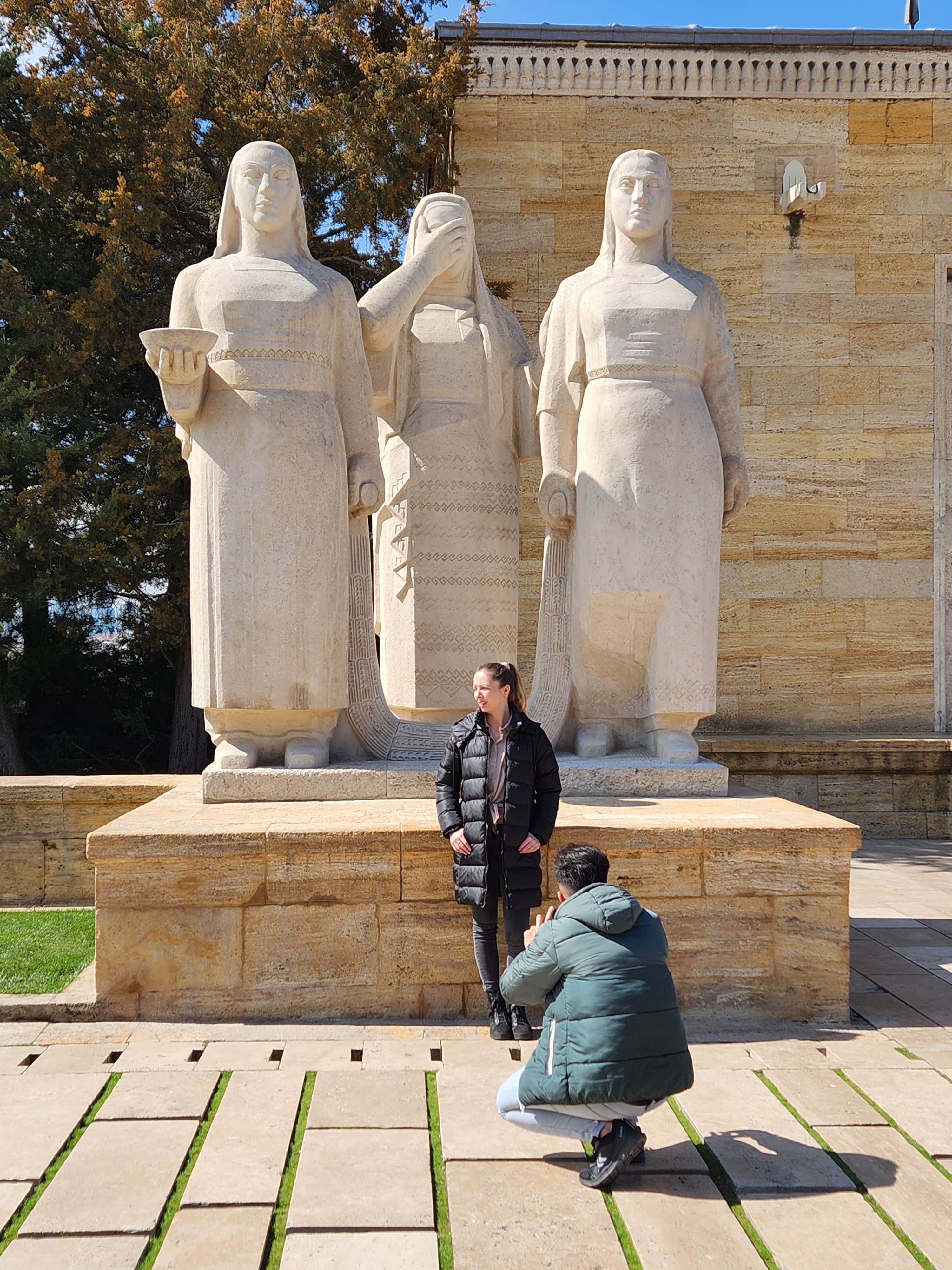 |
| Turkish Men sculpture, located at the entrance of the Road of Lions The two women at the sides are holding a large wreath reaching to the ground. This wreath, made up of grain sheafs, represents the abundant country. The woman on the left with a cup in her stretched-out hand is asking for God's compassion for Atatürk, and the woman in the middle, covering her face with her hand, is crying. |
 |
| Turkish Men sculpture The man at the right with a helmet and coat represents a Turkish soldier; on the left with a book in his hand is a Turkish youth and intellectual; behind both of these, in village clothing, is a Turkish peasant. |
Turkish War of Independence
Guided by Mustafa Kemal Atatürk, the movement’s central military and political figure, the revolutionaries ultimately prevailed. They abolished the Ottoman sultanate on November 1, 1922, and proclaimed the Republic of Turkey on October 29, 1923.
Kemalism
Kemalism, introduced by Mustafa Kemal Atatürk after the Republic’s founding in 1923, was a sweeping program of political, social, cultural, and religious reforms designed to break from the Ottoman past and build a modern, Western‑oriented nation. It served as the guiding philosophy for transforming a multi‑ethnic, multi‑religious empire into a secular, democratic, and unitary Turkish Republic, defining the boundaries of the country’s early reform era.
Atatürk made primary education free and compulsory, opening thousands of new schools nationwide. He replaced the Ottoman script with a Latin‑based Turkish alphabet and expanded civil and political rights—most notably granting women full legal equality during his presidency.


Comments
Post a Comment